A Winnebago For The End Of Days

I love ridiculous titles!

We’re back to RV shopping again!  Winnebago, because they are very popular and among my favorite models of motorhome other than Lazy Daze.  End of Days, because anyone with a frontal lobe can see things aren’t looking too good for modern humans.  Collapse appears to be on the horizon.  No matter, a practical post is in order.  I’m excited for a good change!  I have something of a plan for the next few months to years.  I outlined some of my motivations for living in an RV in 600 sq. ft. Is Too Damn BigLiving Small in a Big World and Mobile Minimalism.  I’m getting down to addressing some important details of this particular lifestyle change.  What kind of RV?  Where to buy it?  Private seller / RV lot?  How are we going to pay for it?  Finance?  Where are we going to park it?  Do we need hookups?  If so, is it a safe area?  Is transportation accessible?  What kind of insurance do we need and how much will it cost?  What are we going to do for extra space?  What about our car?

Ok, hell.  That’s enough of that shit.  We’re looking for a class C motorhome, 28 to 31 ft. long with no slide outs.  That length looks like it will work for us.  The shorter class C’s usually have a living area behind the cab, then a kitchen and immediately behind that is a bathroom/shower in one corner and a goofy bed with a corner cut out in the other.  The corner of the bed is left off so you don’t trip over it getting to the bathroom.  I mean, I want a small space, but that’s too small.  The 28 footers have a walk around bed in a separate room.  At least it feels kind of separate.  I’m also looking for a model that has a sleeper over the cab and ONLY a sleeper.  None of that media center / storage cabinet BS and a crummy little pull out mattress for the youngest kid on a camping trip to sleep on.  We don’t use our bedroom for much of anything now, so it might as well take up as little space as possible:  a loft over the cab.  Nice and cozy.  It’s just the two of us so we don’t need the bed in the back. That’ll be given away.  The mattress usually sit’s over a storage space where the freshwater Read more ›
Tagged with: , , , , , , ,
Posted in Dwelling, Personal, Philosophy

Fight Or Flight In A Culture Of Rot

I don’t know about you, but I have very little invested in United States capitalism, United States empire building, or really anything to do with the United States.  I am human.  I am an Earthling.  I think, feel and metabolize like every other sentient being on this sickly planet.  We seem to be a species on the path of self annihilation and I want no part of it.

One can become paralyzed with fear by reading of all the terrible ways in which the relative calm of the last 10,000 years geologically and meteorologically is becoming disrupted due to anthropogenic climate disruption.  Polar ice caps melting, desertification, acidification of the oceans, overfishing, superweed and superbug breeding through monoculture farming, freshwater aquifer depletion, sea level rise, bee colony collapse, biodiversity loss, radioactive contamination of the air, sea and land.  Shit; pick your poison.  Its somewhat of a privilege to be a witness to such a pivotal time in the history of my species.  We have the ability and technology to save ourselves, but may lack the fortitude to do so.  Collective denial I suppose.

So, when I say I want no part of it, I know very well that I’m a contributor.  Even with my half hearted attempts at a responsible lifestyle.  Instead of recycling more, I try to produce less garbage by not buying packaging.  I bike to work.  I don’t buy much of anything other than food and utilities.  On the scale of the average American, I’m probably on the low end of resource/energy consumption.  Compared to the typical Norwegian, I’m a gluttonous monster. Read more ›

Tagged with: , , , , , ,
Posted in Dwelling, Marxism, Personal, Philosophy

Freedom to Choose Your Tyranny

The practice of an established monarchy is largely dead; the ideology of feudalism, although more common than you think, is met with hostility by most citizens; so, what makes you think capitalism and representative government is the pinnacle of freedom and human achievement as a political economy?  What do you need a boss for anyway; don’t you know your job?  How come you make all that money for those people and are told to be thankful for what they gift you?  What use is all the rhetoric about democracy in the United States when you spend 40+ hours a week living in tyranny?  The rest of the time, you live in a world increasingly crafted so as to coerce you to consume more, produce more, as each iteration brings yet more wealth for them to skim off the top.

The metabolism of human production, aided by technology will bring material wealth and leisure time to fully develop our collective potential.  Money is not the root of all evil.  Government is not inherently corrupt.  Human nature is not one of greed or self interest.  Our salvation shall only be found through the recognition and casting out of the freeloaders in society; the true “Welfare Queens” if you will.  The Capitalist Class.

-M.C. Pletcher

Tagged with: , , , ,
Posted in Marxism, Personal, Philosophy

The Practice of Victim Blaming

Capitalism is an incubator of the very worst behaviors in human beings, and it’s the greed, violence, addiction, gluttony and bigotry that the cynical majority cite as examples to the futility of building an alternative system.  The people I meet can’t dream of anything better; they’re stuck in their version of “reality”, which usually includes blaming the victims of the system rather than the system for creating victims.

-M.C. Pletcher

Tagged with: , ,
Posted in Marxism, Personal, Philosophy

Living Arrangements In The Zombie Apocalypse

Stupid title, I know.  But, where are you going to be when the zombies are upon us?  Do you have a stockpile of food, water, medical supplies, weapons, and a suicide plan if it all goes bad?  I mean, you  don’t want to “live” like that if they bite you right?  I certainly don’t, but I’d sure want to consider that kind of thing.  Stomping around with a vacuous gaze, munching on the neighbors.  Nah.  That’s not for me.  Interesting though.  I like zombie movies, not because I like the gruesome horror of it all, but because such a situation where all infrastructure breaks down and people are forced to care for themselves and each others, create the conditions for interesting human behavior to occur.

No, I don’t foresee the dead becoming animate and feasting on the living.  I doubt any military research facility is working on a “Rage Virus” that causes mammals to become ravenous monsters, tearing each other apart.  None of the typical zombie scenarios are likely and I certainly don’t want them to be.  But, then again, why not play it on the safe side, eh?

This is all very tongue in cheek.  I do have a point here.  To waste your time.  Gotcha!  NO, really.  I have a point.  Even though none of us are going to live through a zombie apocalypse, there are plenty of scenarios in which the fabric of society could break down and you are, as George Carlin said “SOL and JWF.  Shit out of luck and jolly well fucked”.  Asteroid/comet impact, solar storm, nuclear war, plague, supervolcano eruption, to name a few.  Then there’s the possibility of of societal breakdown due to a minor event because of an already weakened infrastructure, lack of emergency preparedness and the irrationality of the existing institutions attempting to maintain control over a frightened public.

So, there are a lot of reasons to live light, be prepared, know myself, enjoy seeing the world, develop personally, and if the day comes where I think I might die, well…  at least I tried to fill everyday with as much experience and beauty that I could muster.  Why zombies then?  Because survival is survival no matter which scenario I’m talking about.  Only the details are different.  When I go off and live an “abnormal lifestyle” such as living in a motor home at 27 years old with no specific goals other than personal growth and experience, folks are bound to ask “why?”.  Telling them I want to live small, with less and be mobile in case any one of those disasters occur, and I get labelled as being paranoid.  On the other hand, if I say I’m preparing for the zombie apocalypse I either get labeled as insane and they go away, or they become intrigued in which case, I just gained a friend.  SImple as that.  I don’t know about you, but my favorite Walking Dead character was Dale with his motor home.  That guy was prepared.  🙂

-M.C. Pletcher

Tagged with: , , , , , , ,
Posted in Dwelling, Personal, Philosophy

Empathy For Corporations. Really

I don’t necessarily blame greedy corporations for their actions.  Their corporate charters (by law), require them to produce a profit for their shareholders regardless of the social, economic or environmental consequences.  Corporate monopolies and destruction of small business is the natural course of capitalism.  The greater the government regulations protecting the public, the less power these companies have.  Unfortunately, with control of greater portion of the country’s wealth, these companies can (and do) weaken these protective regulations, lower their own taxes, drum up the war beat on profitable but destructive wars, manipulate public opinion into privatizing public institutions and property and through ownership of the majority of media outlets and influence in the education system, ensure the continuation of an economic system that privatizes profit while socializing costs.  I’m afraid this notion that the problems today could be solved if only people had better work ethic, government would get off our back and people weren’t so damn greedy; but the groups advancing this view are the ones who continue to gain the most from it.  Seen from an outside perspective, there are very limited freedoms in a capitalistic society, even if it is claimed to be politically democratic.  There are alternatives to capitalism available and we can change the system now while there is still a livable planet and resources left, or we can let the destructiveness of capitalism take it’s course until it cannot expand any longer on a finite planet and our civilization goes out as the biggest “flash in the pan” of recorded human history.

-M.C. Pletcher

Tagged with: , , , , , , , , , , ,
Posted in Marxism, Personal, Philosophy

There Are No Monsters

Many people find it intolerable that I can empathize with everyone; from the lying drug addict to the hedge fund manager that pissed away your college fund.  Even a serial killer wasn’t just born a sociopath, there are reasons for these behaviors.  I certainly don’t condone drug addiction, murder or exploitation, but in the right context I can understand how a human being could make a series of choices leading to awful acts.  We can turn away from these people, these very human behaviors and banish them to a cell somewhere or often subject the poor to continue living in the impoverished conditions they supposedly “choose” to live in, or we can attempt to become an enlightened society which recognizes our inate weaknesses, the prison that is one’s perceptive view, and empathize with one another for becoming the product of environmental influence.  Anything short of this absolute and unconditional empathy for others requires the absurd notion of “evil”, a superstition rooted in ignorance.  “Choice” is a matter of available options.  Context is universal.  Context is everything.

-M.C. Pletcher

Tagged with: , , , , , ,
Posted in Marxism, Organized Entropy Expansion, Personal, Philosophy

Reform or Revolution?

American history is not one of revolution, but of reforms to quiet and appease a restless populace.  From the beginning, we have lived in a class society; the majority who perform the work and the minority which make the lion’s share of economic decisions, the rest of us must live with.  How much longer will people fight for rights, granted by minor reforms, that in an equal society would be unwritten, unspoken and universal?

-M.C. Pletcher

Tagged with: , , , , , , ,
Posted in Marxism, Personal, Philosophy

Organized Entropy Expansion #1

I don’t like shopping.  I buy used, if I buy at all.  Sports are dumb.  The TV is a propaganda box.  Guns are a tool and should not be idolized.  “The sanctity of marriage”, is a phrase uttered by bigots.  Honey-Boo-Boo is a cultural tragedy.  God doesn’t exist; we have to take care of each other.  The United States empire is by far the largest and most destructive global terrorist entity to ever exist.  I’m pro-choice; pro-woman more like it.  Peeps are not edible.  Fur REALLY is murder.  Corporations are the most egregious welfare queens.  “Single use disposable”, is an insane concept.  Capitalism is killing the biosphere.  We should be space travelers instead of committing suicide.   An enlightened society doesn’t eat other sentient beings . I am the universe thinking about itself, and you are a figment of your own imagination.  Together, we are the stewards of the cosmos, gardeners of the possible, creators of complexity.  We are god, and should start acting like it.  Don’t eat peeps; they suck.

-M.C. Pletcher

Tagged with: , , , , , ,
Posted in Marxism, Organized Entropy Expansion, Personal, Philosophy

A Comprehensive Collection

So, I’ve had this little conundrum for a couple years now:  I want to own a home, someplace to call my own that facilitates my lifestyle and I can build it to suit my needs, but I don’t know where it is I want to live or what it is I’m doing with the remainder of my days.  So, I rent.  I give money to someone that owns land and structures (probably a bunch of them), and they use that money as income and live off of my  indecision to settle down somewhere.  I don’t want a home as a financial investment.  My home is for living, not for selling.  I couldn’t care less about the marketability of some off grid Earthen home I build for the Mrs and I.   Forget real estate values, homes are for living.

All the homes I’ve wanted to build, and there are a few….hundred, require a heavy investment into the local area.  As in, to build an Earthen home or cob, strawbale, timber frame, cordwood, Earth Bag, Compressed Earth Brick, etc., requires a lot of time and effort.  I figure I better be really comfortable in the corner of the world chosen before taking such drastic steps as “digging in”.  Not to say I wasn’t pretty close to doing just that on a few occasions.  We wanted land.  Like a fair chunk of land:  10 to 30 acres and we were going to pay cash.  It had to be in some county where we wouldn’t be too bothered about building codes and what not.  Someplace out of the way.  No utilities available?  Great!  Don’t need ’em or want ’em.

Well, plans change.

I still love the idea of building the Earthen home, but my realizing that there’s a whole lot of the world I haven’t seen yet, it’s simply out of the question now.  I know what would’ve happened.  We would’ve bought our land, built a small home as funds would allow for it and slowly add on to it with weird and wild additions, trying all sorts of construction techniques, until it had grown with us so long we couldn’t leave it.  Also, I’m concerned that without pushing the boundaries of my comfort zone, I’ll just live in the woods and grow ever more cynical and jaded about a society I’ve largely cut ties to.  Then there’s the cats.  Many cats.  A cat haven.  A cat kingdom.  Living with cats make traveling difficult.  Homesteads are for staying put.  I can’t have that.

So, here I am.  Working 50+ hours a week driving around a truck making someone else a lot of money.  It’s not particularly satisfying, but it’s a job skill that travels well.  I’m highly opinionated, pissed off at the society I was born into, scared of the what the future holds, and uncertain as to what to do about it.  I, like many others feel disconnected, without a sense of community, vulnerable to the institutionalized violence that purveys neoliberal capitalism.  I desire the comfort in knowing what I do has purpose, not necessarily for others, but for me alone.  For people I know, I seem to have an unusual ethical code based in the Marxist tradition and opinions on world events heavily influenced by people’s struggles and not history as dictated by dominant institutions past and present.  I wish to take part in these struggles, but feel socially and emotionally stunted due partly to a lack of personal expression through the passions for which I know have talent for.

I should conduct my life as a gardener grows a bountiful, healthy garden; by pulling out the weeds of unnecessary negative influences so that I can better nurture the beautiful, productive yet vulnerable fruits until they have grown so robust and vigorous so as to shade out those influences that keep me from fulfilling my potential as a human being.

A lousy and naive metaphor for a comprehensive collection of personal insecurities.

-M.C. Pletcher

Tagged with: , , , , , , ,
Posted in Dwelling, Marxism, Personal, Philosophy

Mobile Minimalism

I’m no minimalist.  I don’t really know what that would look like.  No such person, I suppose, but I like the ideology of minimalism.  I tend to be an excessivist.  Hmmm.  Red Underline.  My word?  Anyway, I do things excessively.  I drink too much coffee.  I eat until my belly hurts and I’m sick.  I can’t drink one beer, I drink all the beers.  Shit, I put too much peanut butter on a PB&J.  If something is good then more is better, right?  Well, I’m not so sure.

I have too many interests and not enough lifetimes to fulfill them all.  So many projects and hobbies I’d like to explore, but it all seems to overwhelming sometimes without some sort of basic structure or routine to my day other than going to my hourly wage job.  Just the simple act of keeping my living space clean is somehow beyond my abilities.  To me, minimalism isn’t about living with next to nothing, it’s about living with just what makes you happy and no more.  Anything extra; more possessions, more space, more vehicles to maintain, just takes away time and energy better suited towards my true passions.  Passions, that I may not even consider at this point.  Some people are highly organized and can juggle a full calendar of activities and responsibilities.  I am not one of those people.  Maybe, it takes motivation for a goal or series of goals, for which I have few or at least I don’t have a plan to get there.  For myself, minimalism is about priorities.  If something isn’t important to me, get rid of it!  I hope that by adopting such a philosophy, I can create an environment that is suited for my goals, and those goals will dictate the environment that follows. Read more ›

Tagged with: , , , , , , ,
Posted in Dwelling, Personal, Philosophy

Living Small in a Big World

So, I was rambling yesterday about living situations and 600 square feet being too damn big.  Well, we’ve gone through a number of changes about how and where we want to live.  The ‘where’ is anybodies guess, but that helps determine the ‘how’.  For one thing, we’ve decided we favor smaller, more compact living.  Apartments do come in smaller sizes than this one, but that would involve another move into someone else’s dwelling again and I detest moving.  Again, another clue to the question of how we want to live.

Smaller just makes sense.  My wife likes to say that her favorite place to live has always been a small single room apartment plus bath.  You’d walk in the door, you see four walls and that was pretty much it.  Yet, she was happy there.  It was cozy and she had just about everything she needed, easily accessed more or less. Read more ›

Tagged with: , , , , ,
Posted in Dwelling, Personal, Philosophy

600 sq. ft. Is Too Damn Big

So, I rent.  We rent.  I’ve always rented ever since I moved out of my parents home.  FIrst, $300 a month, then $450, and now $895.  That’s a lot of money I’ll never see again, but that’s the cost to avoid being stuck in one place.  If I decide I want new living arrangements, a different kitchen, a garage or an entirely different city, I can up and move.  But, the rent is too damn high!  As Jimmy McMillan would say.  Sure, I can afford it and have plenty left over for great food and a healthy savings account.  But, if I had that money to put into something useful like a hobby or a place I can call my own; shouldn’t I try?

There is, of course, the dreaded MORTGAGE.  Which, I’ve read is Latin for “Death Pledge”.  I don’t know about you, but I don’t really want anything to do with something that has the word “death” in it.   Read more ›

Tagged with: , , , ,
Posted in Dwelling, Personal, Philosophy

A Slight Change Of Course

So, I haven’t been writing in a while.  I miss writing on this blog; it helps me think and get my head in order.  For months I was in a new city and unemployed, so I had a lot of time on my hands and a desire to collect old refrigeration texts.  I started keeping a journal and enjoyed it so much I began this blog.  I’ve never been so enthralled by a subject as I was reading about the development of vapor compression systems and their beautiful craftsmanship before manufacturing monopolies consolidated the designs and adulterated the quality and repairability of these common household appliances.

I’ve been working a few months now and although I’m still reading regularly, the writing has fallen by the wayside along with the plans to build my own machines.  It’s so easy to work all day doing something you wouldn’t do for free and come home to plop down on the couch, crack open a beer, eat dinner and watch The Daily Show on Hulu before retiring for another day of passionless work.  The work lets me see the city and I spend most of the day by myself listening to the radio or podcasts.

If you haven’t noticed, I’m taking a more personal course with this post.  Things change.  People change.  Blogs change.  I intend to focus on heating, cooling and energy reclamation topics, but some changes need to take place in my life to make that happen.

M.C. Pletcher

Posted in Personal

An Analysis of a Construction Equipment Rental Company

Tool Rental

I work for a construction tool rental company based out of Seattle, Washington.  My time in the Portland, Oregon branch, although brief compared to the average employee, has led me to make a few small observations about the day to day logistics and operation of not only this particular branch, but to the rental industry in general.

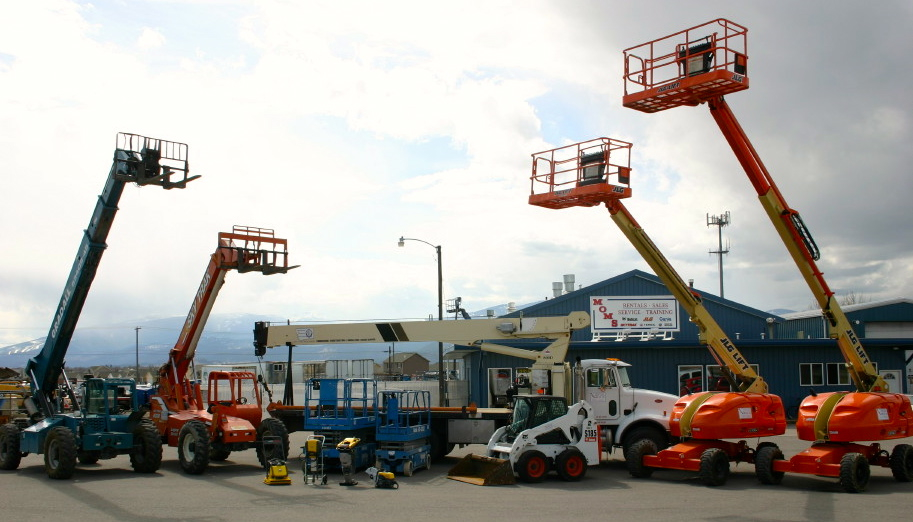
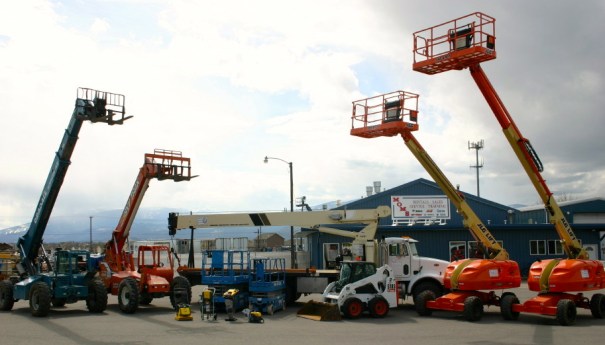
The majority of the equipment handled by the rental company is what one would typically find on any construction or demolition site.  All manner of large reach fork lifts, aerial work platforms, backhoes, skid steers, excavator, scissor lift are quite common down to smaller tools like saws, vibrators, compactors, chipping guns, rotary hammers, heaters, fans and the like.  Most of these tools are of high quality, commercial grade with reliability of operation expected by professional contractors.

Rental agreements usually charge a usage fee based on the number of days or weeks rented, hours of machine operation, consumables like, saw blades, chisels and fuel, as well as delivery and pickup fees.  Also, any unreasonable damage or wear to a piece of equipment will incur additional charges.  These rental contracts likely represent the majority business of this rental company although some revenue is gained through the sale of both used and new equipment as well.

The rental time period can be as little as a few hours to several months in the case of industrial forklifts and aerial work platforms.  As equipment is returned to the shop facility, any necessary maintenance is performed and the item is once again ready for rent.  In the case of small tools such as electric breakers (jack hammers), one may go through a dozen iterations of this process in a business week.  The Portland store represents a very busy hub amongst a network of other branches throughout the north west and requires the accumulated efforts of warehouse personnel, mechanics, office clerks, truck drivers, accountants, sales people, human resources and all manner of managers or administrators.  It is the source of value (money) and the distribution within the enterprise that is of interest to me.

I would offer that the first, and likely smallest contributing source of revenue, is from sales of new equipment.  When the opportunity arises for the purchase of discounted, wholesale construction tools; office administrators, using company assets, purchase a number of them and then “mark them up” or otherwise sell them for a amount over and above the original purchase price.  This has been referred to as “mercantile capitalism” by some.   Read more ›

Tagged with: , , , , , , , , ,
Posted in Marxism, Uncategorized

On the Subject of Everything

What is humanity’s role in the universe?  I don’t ask this question as though there is some sort of definite answer sought after for ages only needing decoded from some ancient religious scripture handed down from an omnipotent grand creator.  Xenu perhaps?  Haha.  Don’t sue me you silly Scientologists.  What I mean is a story of ourselves.  An image, philosophy or set of ideals for which all humankind that uses science and reason to postulate a story of our past present and how that shapes the future.  After all, the ability to tell a story seems to one of our most defining features.

I see that story in terms of entropy.  That is, after all, the overriding subject of this blog and even though up until now the bulk of witing has been on the subject of vapor compression systems, it is an appreciation of the history of the universe, the Earth, geology, the development of biologic life and most recently, memes and memetic proliferation of information that leads to so many questions as to how entropy played a role in all of these processes.  The truth is, in discussions of these subjects, I see the greatest insight by defining them in terms of entropy.

Biologic life, far from being easy to discuss, is often a starting point in thinking about the world in terms of entropy. Read more ›

Tagged with: , , , , , , ,
Posted in Philosophy

The KillCap Catalogue

I enjoy designing vapor compression machines.  It all started with a refrigerator.  I have thought long and hard on how these mainstays of modern living could be improved and someday I will make some of them a reality.  In the meantime, I daydream, I read, I study, observe, ponder and write.  Opportunities abound to use, re-use and then use again, the energy that keeps us warm, heats our water and even the energy we reject to keep ourselves cool, freeze perishables or the unwanted humidity in drying clothes on a rainy day.  We have machines to perform these tasks (at least the wealthy on Earth do), but the energy they consume to operate and the resources to replace them when they become defunct and unrepairable is certainly unsustainable and a testament to the waste of a capitalist system obsessed with unbounded expansion and addiction to overproduction and the artificial scarcity to drive it all.  It could be argued that these technologies were developed within the very same system so some good things have come from it.  I suppose so, but the implementation of climate control and labor saving devices is done in such an manner as to never solve these ago old problems, but instead, make us more comfortable for a while as the resources of the planet are pissed away like beer at a frat party, leaving the population vulnerable as we try to learn the harsh lessons of living within the natural laws of the planet.

We do not have to take cold showers or sweat in our homes on a hot day.  We live on a planet of abundance, bathed in sunlight energy, Read more ›

Tagged with: , , , , , ,
Posted in Dehumidifiers, Hot Water, Philosophy, Refrigeration, Refrigerator

The Great Gravity Flooded Evaporator

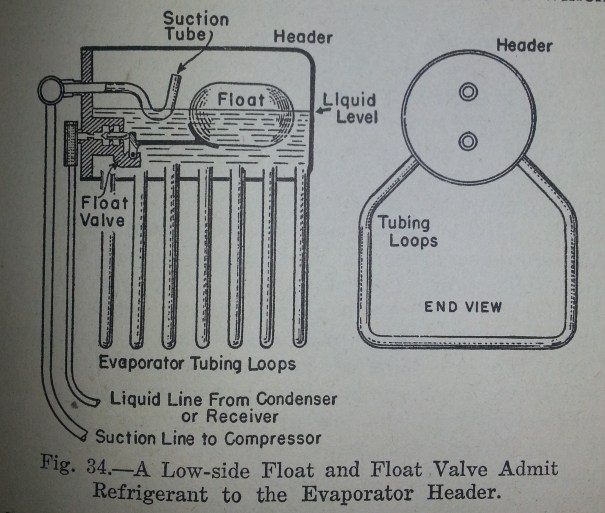
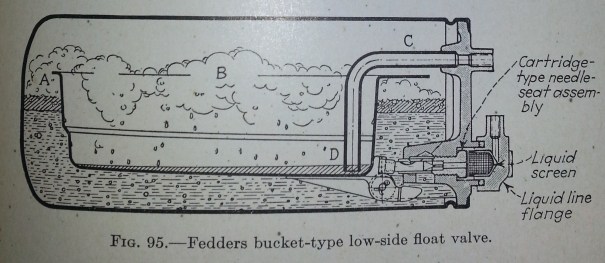
I’ve grown quite fond of the gravity flooded evaporator in the last year or two.  It has a number of advantages over a dry type evaporator.  I’ve discussed some of these in previous posts (here and here) and I will no doubt reiterate some of them today.  First, to define the differences between a gravity flooded evaporator and a conventional dry, saturated evaporator.

Dry_Evaporator

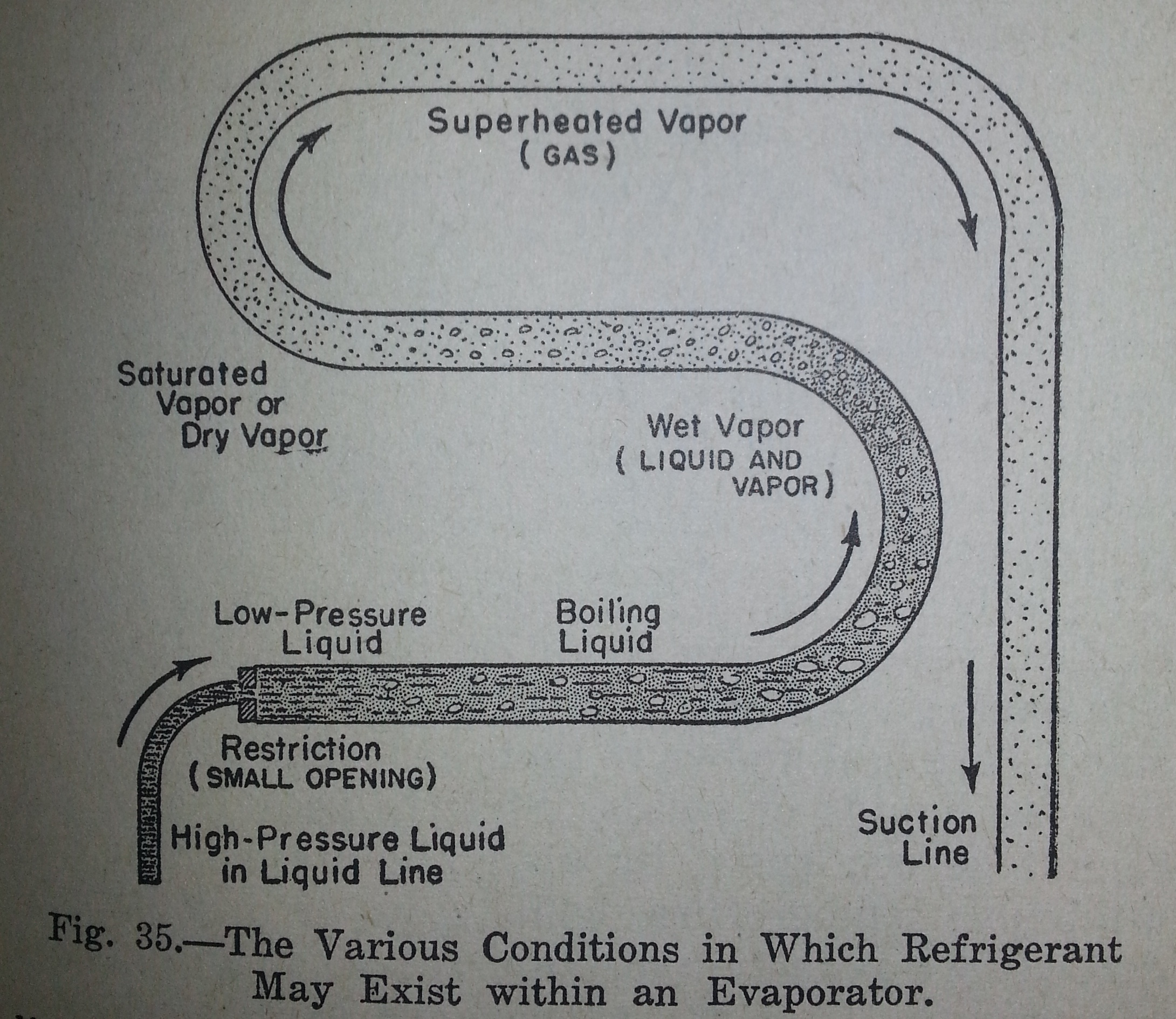
Somewhat briefly; the above is a quite simple illustration of a dry evaporator.  Essentially it consists of a passage of tubes or tubes that carry a low pressure liquid refrigerant undergoing phase change admitted through a restrictive orifice of some sort, that creates a pressure drop between the high pressure condensing side of a vapor compression system, and the suction side.  As the low pressure liquid is exposed to the warm inner wall of the tubing, it vaporizes and cools the tube or tubes.  The chilled tube in turn absorbs heat from the local environment, whether that is air, water or some other medium.  The amount of refrigerant admitted into the evaporator must be controlled so that, given the conditions of the system, all of the refrigerant vaporizes without any substantial rise in temperature.  If too much refrigerant is admitted, not all of it vaporizes and liquid is drawn back to the compressor where it can cause damage.  Both of these situations are to be avoided, but it is more likely that the system will be operated in a slightly starved condition so as to avoid mechanical damage.  The superheated vapor has a minimal refrigerating effect and can greatly reduce the overall mass flow rate in the system.

Better system performance is generally seen when the higher suction pressure can be maintained, which means a smaller temperature difference between the refrigerant and the environment.  One way this is done, is by increasing the heat transfer surface area.  In atmospheric evaporators, heat conducting fins absorb heat more effectively than the tubing alone.  Increasing the length of the evaporator tubing also adds heat transfer surface area, which is done in addition to fins and often a circulating fan or pump to move the cooled medium across the metallic surfaces.  Unfortunately,  increasing the length of the tubing has a very nasty consequence: pressure drop.

Pressure Drop Sucks!  (so to speak)

Pressure drop happens and cannot be avoided, as far as I know.   Read more ›

Tagged with: , , , ,
Posted in Refrigeration

1930s Household Refrigerators

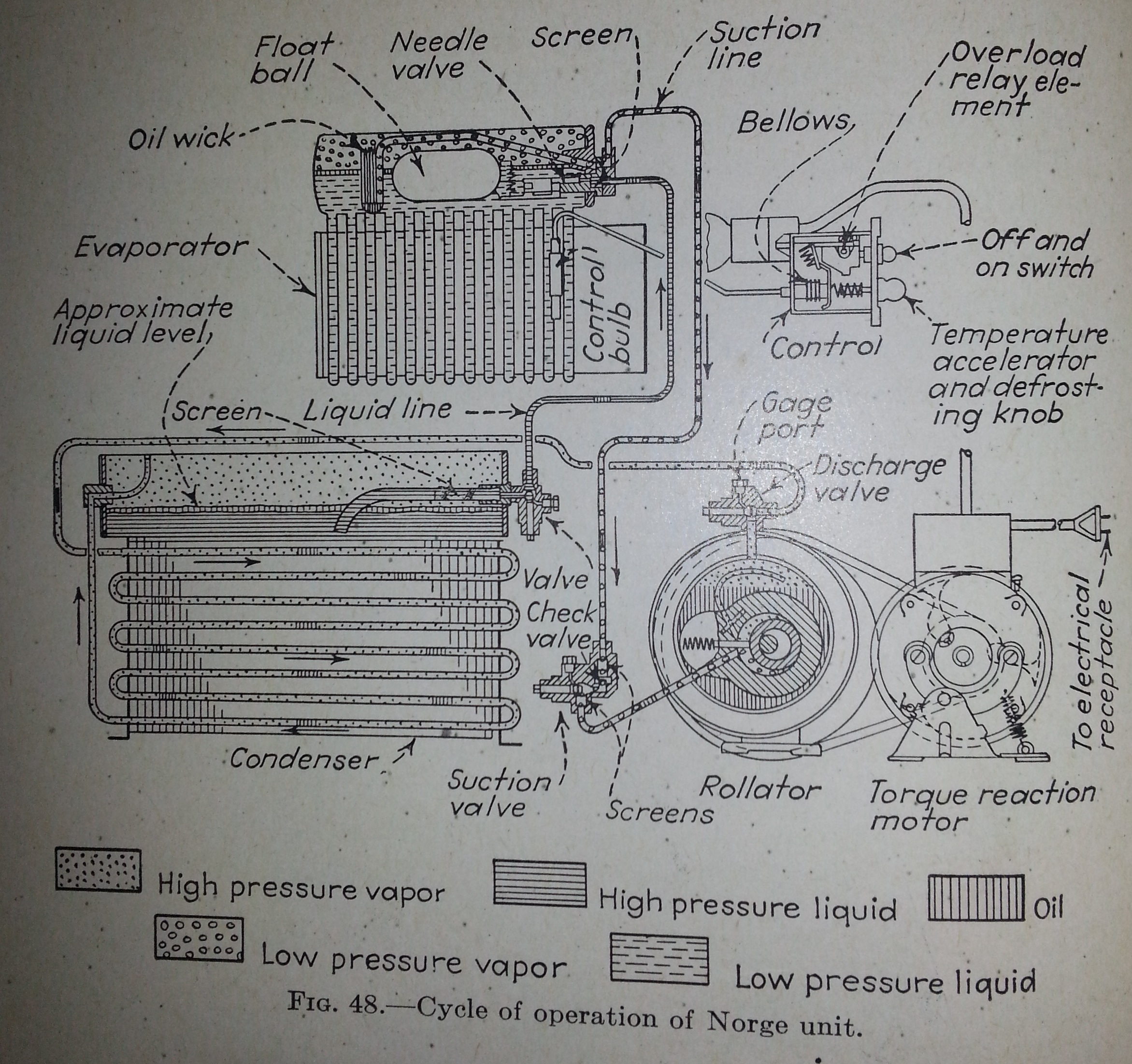
The evolution of the household refrigerator is not a well known story.  There seems to be few people interested in the subject.  Perhaps it is not as romantic as the development of the automobile.  Nonetheless, a concerted effort was put forth in the 1920s and 1930s to produce a cheap, reliable, efficient domestic refrigerator.  From books I’m reading on the subject, the great diversity of refrigerator manufacturers in the United States that existed in the 1920s, seems to be boiled down to a handful of companies in the depression era.  In the most recent book, “Household Electric Refrigeration” by John F. Wostrel and John G. Praetz 1938; the models described were made by manufacturers, many still around today (or owned by yet larger companies) including General Electric, Frigidaire, Kelvinator, Norge, Grunow, Crosley, Sparton, Hotpoint, Coldspot, Copeland, Ice-O-Matic and Westinghouse.

Norge_Operation

One of the most noticeable differences between refrigerators in the mid 1930s and today was the refrigerants they used and the refrigerants charges required for operation.  A very common refrigerant, Sulpher Dioxide had been in use fora number of years and still appeared to dominate the market at this time, not to say that proprietary chemical refrigerants weren’t beginning to take a large part of the market.  F-12 was one of these proprietary substances that would later dominate the refrigerator industry.  It was stable up to high temperatures, didn’t stink like SO2 when it leaked, was relatively safe if exposure to it was kept to a minimum, and it has a much lower boiling point than several common refrigerants at the time which means that systems operating F-12 remained in a positive pressure state throughout the cycle.  Refrigerators with F-114, SO2, Isobutane and Methyl Formate required a vacuum in the low side of a vapor compression system.  This was generally viewed as problematic seeing that if a leak formed in the low side of the system, for instance, around the packing seal of an open drive compressor, atmosphere would leak into the system, bringing non-condensable gases and water vapor.  This leads to high head pressures, oil contamination, possible acid formation, corrosion and refrigerant control freeze ups.  A curious refrigerant used rarely was Carrene, also known as Dichloromethane which has a boiling point of 104 degrees F at atmospheric pressure.  This means both the suction and discharge sides of a system would operate in a vacuum state.  Very curious.  As I said, the refrigerant charges were unusual as well.  The compressors of these systems were rated not much  larger than modern day compressors from 1/16 HP up to 1/4 HP, but they had typical charges of 1# to perhaps 3.5#  and more depending on the manufacturer.  Modern refrigerators have charges measured in ounces, perhaps, 4 oz.. Most of these machines had liquid receivers that held excess refrigerant and ensured a pure liquid supply to the refrigerant control.  That excess refrigerant would have allowed continued operation with minor leaks in the system.  Another reason for the large charges is the construction of the evaporator which was commonly gravity flooded; a vessel and series of tubes holding refrigerant under low pressure, boiling away to vapor as heat is absorbed from the refrigerated cabinet. Read more ›

Tagged with: , , , , , , ,
Posted in Old Refrigeration Texts, Refrigeration, Refrigerator

Modular Refrigerator Circa 1935

Sheet_Metal_Modular_Evaporator

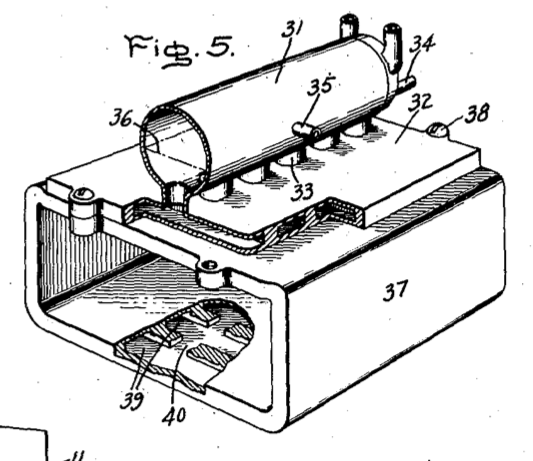
This curious little gem here is a modular refrigerator evaporator from a US patent granted 1935.  Available here.  The purpose of the invention being that it allows for the removal or replacement of a refrigerator’s evaporator coil (or at least part of it), without opening the refrigerator’s vapor compression system, risking a leak, air or water contamination.  Of particular concern at this time in history was the damage a refrigerator owner could do to the cooling coils when defrosting them by puncturing the coil with a scraper or ice pick.  These early refrigerators were designed with the evaporator coil in a shape to receive ice trays for freezing.  Extended use could leave wear to any enamel finish, so a replaceable evaporator coil could be an advantage.  Also, adding or removing secondary evaporators allows one to change the system capacity.

Modular_Evaporator_Installed

This modularity was designed for the flooded type evaporator which was not uncommon in the late 1920s and early 1930s.  More information on flooded evaporators here and here and some old machines here.  The volume of the coil was literally “flooded” with low pressure liquid refrigerant and the suction pressure was determined by the volumetric efficiency, displacement and speed of the compressor as well as the properties of the refrigerant, boiling temperature and pressure, and refrigerator load and surface area of the evaporator itself.  The beauty of these systems was that they barely superheated the refrigerant and couldn’t return liquid refrigerant to the compressor if employed well.  The level of refrigerant within the evaporating chamber was maintained by either a float valve within the chamber or a float valve in the high side of the system as is likely in the depiction on the right.

Secondary_Evaporator

The early forms of these evaporators were a horizontal copper or steel cylinder with small tube loops extending out and downward in order to increase surface area.  Later, thin aluminum sheets were stamped with grooves and welded together to form a fluted channel and then bonded to the cylinder supplying refrigerant.  That is the construction seen in these diagrams.  The secondary evaporator is built similar to the primary, working evaporator except it does not share a common supply of refrigerant.  The secondary is sealed with refrigerant inside, filled part of the way up.  When it is firmly in good thermal contact with the primary evaporator coil, heat absorbed by the refrigerant in the secondary would boil, forming a vapor that once in contact with the inside top surface would be cooled to condensation by the boiling of the refrigerant in the primary evaporator where the vapors were then drawn back through the suction line to the compressor.  This secondary represents a form of a heat pipe.  Pretty cool huh?

Cast_Modular_Evaporator

According to the inventor, this concept can be realized in forms other than the stamped metal seen above, but could also the of the cast type.  In the diagram to the right, the majority of the cooling unit is removable with the loosening of a few bolts.  I don’t know if any refrigerators employing this modular technology were ever put into production.

M.C. Pletcher

Tagged with: , ,
Posted in Refrigeration, Refrigerator

Enter your email address to follow this blog and receive notifications of new posts by email.

Join 308 other subscribers